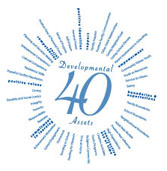
 What Are Developmental Assets? What Are Developmental Assets?
Building Blocks for Raising Healthy Children and Youth
Since its creation in 1990, Search Institute’s framework of Developmental Assets has become the most widely used approach to positive youth development in the United States.
Background—Grounded in extensive research in youth development, resiliency, and prevention, the Developmental Assets represent the relationships, opportunities, and personal qualities that young people need to avoid risks and to thrive.
The Power of Assets—Studies of more than 2.2 million young people in the United States consistently show that the more assets young people have, the less likely they are to engage in a wide range of high-risk behaviors (see table below) and the more likely they are to thrive. Assets have power for all young people, regardless of their gender, economic status, family, or race/ethnicity. Furthermore, levels of assets are better predictors of high-risk involvement and thriving than poverty or being from a single-parent family.
The Gap—The average young person experiences fewer than half of the 40 assets. Boys experience three fewer assets than girls (17.2 assets for boys vs. 19.9 for girls). Percentage of 6th- to 12th-Grade Youth Reporting Selected High-Risk Behavior Patterns, by Level of Developmental Assets* | High-Risk Behavior Pattern | 0–10 Assets | 11–20 Assets | 21–30 Assets | 31–40 Assets | Problem alcohol use—Has used alcohol three or more times in the past month or got drunk once in the past two weeks. | 45 | 26 | 11 | 3 | Violence—Has engaged in three or more acts of fighting, hitting, injuring a person, carrying or using a weapon, or threatening physical harm in the past year. | 62 | 38 | 18 | 6 | School Problems—Has skipped school two or more days in the past month and/or has below a C average. | 44 | 23 | 10 | 4 | * Data based on aggregate Search Institute sample of 148,189 students across the United States surveyed in 2003. |
Implementation
40 Developmental Assets will be implemented in all Montebello Unified School District schools:
For additional information on this program contact: Michael Ladjevic at
ladjevic_michael@montebello.k12.ca.us |  | View the list below and click on the asset you want to build! | | |
|

 40 Assets for Early Childhood